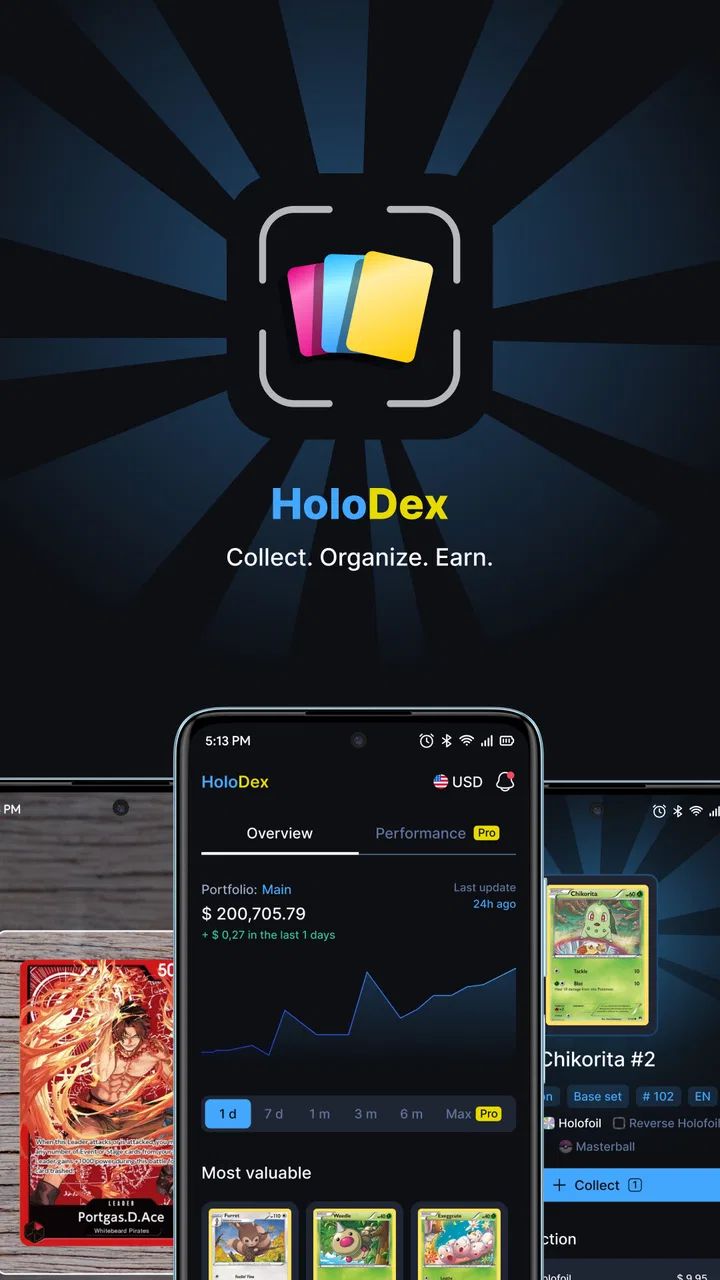
HoloDex - TCG Scan & Collect
- 4.7
- Rating
- 1.00M
- Installs
- Free
- Price

 Analysis by App-foxy
I find card-collection apps most useful when they reduce the small bits of friction that make a hobby feel like paperwork. HoloDex - TCG Scan & Collect is built around that idea: it helps me keep track of a TCG collection, arrange cards by set, and follow what those cards are worth. It is a free Tools app from Mavelli, aimed at Everyone, and its focus is practical rather than flashy.
After spending time with it, my impression is that HoloDex works best as a personal collection companion. It is not trying to replace the experience of opening packs, trading face to face, or studying a physical card binder. Instead, it gives those activities a more usable digital record. That distinction matters, because the app is most valuable when I use it to answer everyday questions: Which cards do I already own? What is missing from a set? Is a card worth checking before I trade it away?
The app has attracted a 4.7 average from around 18 thousand ratings and has passed 500 thousand installs. Those figures suggest that its basic purpose is easy for many collectors to understand. The current version is 1.0.22, and it runs on Android 7.0 or later. HoloDex is free to install, while optional purchases range from $4.99 to $49.99 per item, so I would treat the free experience as the starting point and look closely at any upgrade screen before paying.
You May Also Like

 Blood Strike: 2.5 Anniversary
Blood Strike’s Loadouts Turn Every Drop Into a Tactical Gamble
A close look at Blood Strike’s custom loadouts: how fast access to signature weapons reshapes its battle royale rhythm, rewards preparation, and narrows the gap between fights.

 Pandora - Music & Podcasts
Pandora’s Music Is Easy to Start, but Harder to Recover
Pandora’s strength is its low-effort path from a seed to a station. Its weak spot is how much confidence it asks you to place in connection, setup, and quiet recovery.

 8 Ball Pool
 Is Built on Rivalries, Rematches, and Routine
A close look at the rivalries, rematches, shared routines, and unanswered safety questions that turn a quick pool match into a persistent mobile community.

 Samsung Music
’s Quiet Strength Is Playing What You Already Own
Its reach comes less from spectacle than from dependable access to a personal library. That simplicity is both the app’s strongest retention engine and its ceiling.

 AccuWeather: Weather Radar
AccuWeather Review: A Quick, Clear Forecast for Everyday Decisions
For everyday plans, the best forecast is the one you can understand quickly. AccuWeather makes rain timing, radar, and local conditions easy to act on, with a few trade-offs.

 Hill Climb Racing
Why Hill Climb Racing Still Turns Crashes Into One More Run
A tiny car, a bumpy hill and one more upgrade: Hill Climb Racing keeps resurfacing because its simple chaos makes every near-miss feel personal.
More From Our News Desk



How clearly HoloDex presents a collection
I find a collection easiest to manage when its records help me make a decision, not just admire a total. This section looks at how HoloDex’s set-based organization can turn a scattered inventory into a clearer picture of progress, duplicates, and gaps. I’ll also consider why a tidy digital view is most useful when it stays connected to the cards you actually own.
Readable organization instead of a crowded card database
The strongest part of the concept is the way it separates collection management into familiar ideas. Cards, sets, and value are different questions, and HoloDex gives each one a sensible place in the overall workflow. I do not have to think like a database administrator to understand what I am trying to do. I can approach the app as a collector who wants a clearer view of physical items.
That matters for readability. A collection can become difficult to follow when every card appears as one long stream, especially after adding cards from several expansions. Organizing by set gives me a more useful mental map. I can look at a particular release, see how far I have progressed, and decide whether I am collecting broadly or concentrating on completing one group first.
I also appreciate that the app’s purpose is visible from the start. The name HoloDex - TCG Scan & Collect tells me that scanning and cataloging are central activities, while the collection tools give the scan a practical destination. A scan is not useful merely because it is quick; it becomes useful when it saves me from repeatedly typing card details or trying to remember where a card belongs.
Why the set view can change collecting habits
For me, set organization is more valuable than a simple total-card count. A total tells me how large my collection is, but it does not tell me what kind of progress I am making. A set-based view can reveal that I am close to finishing one group while barely starting another. That changes how I spend time and money, particularly if I am deciding whether to keep buying packs or focus on trades.
A practical workflow is to add cards after sorting a newly opened batch, then review the relevant set rather than trying to update everything at once. This reduces the chance of forgetting which cards were already logged. I would also use the app before attending a trade meet: checking a set view beforehand helps me identify duplicates and gaps while the information is still fresh.
There is a small but important trade-off here. Digital organization only helps if I keep it current. If I scan a few cards and leave the rest in a box, the app becomes an incomplete picture. HoloDex can make a collection easier to understand, but it cannot automatically solve inconsistent cataloging habits. I get the best results when I treat it as part of the sorting routine rather than as a record I update once every few months.
Using value information without letting it dominate
The value-tracking side is useful as a reference point, not as a promise of what I will actually receive for a card. A displayed worth can help me notice which cards deserve sleeves, safer storage, or a second look before a trade. It can also make a large collection less mysterious by showing where the more significant pieces are concentrated.
I would avoid treating the number as a guaranteed sale price. Real trades depend on condition, language, demand, timing, and the person standing across from me. HoloDex is most helpful when it answers, “Is this worth investigating?” rather than, “What exact amount will I get today?” That distinction keeps the tool grounded and prevents a digital estimate from creating unrealistic expectations.
One useful habit is to separate cataloging from valuation. First, I would make sure the correct card is attached to the correct set and collection entry. Only then would I use the value information to prioritize cards for closer inspection. This two-step approach is especially helpful for collectors who own visually similar cards and do not want a mistaken entry to influence their decisions.
Navigation for different levels of experience
HoloDex should feel approachable to someone who has just started collecting, because the main tasks are recognizable: scan, organize, and review. A beginner can use it as a digital checklist without needing to understand every detail of the wider TCG market. For an experienced collector, the appeal is different: the app can reduce repetitive checking and provide a faster overview of a larger inventory.
That difference in experience also affects how much guidance a person needs. A new collector may need to slow down and confirm each entry, while a long-time collector may prefer a rapid capture-and-sort routine. I would not assume that the quickest workflow is automatically the best one. Accuracy is more valuable than speed when a collection contains similar artwork, multiple printings, or cards acquired from different sources.
For readers with visual or cognitive needs, the clear separation between collection tasks is a positive starting point. I find it easier to work through one question at a time than to interpret a screen filled with unrelated totals, prices, and card details. Still, users should judge the actual text size, contrast, image treatment, and control spacing on their own device. Those details can vary with the phone, display settings, and personal needs.
Using the app across abilities and situations
A card catalog needs to work in more than one perfect, quiet session, so I look at how the scanning-and-sorting idea fits real routines and different levels of comfort. This section considers practical adjustments—such as working in small batches or choosing a stable surface—that can make collection upkeep less tiring. It also sets up a closer look at where the approach has limits.
Motor considerations during scanning and sorting
Scanning suggests a potentially convenient alternative to typing every card manually. For someone who finds repeated text entry tiring or uncomfortable, that can make collection maintenance more manageable. The benefit is greatest when I am processing a stack of cards and want to capture the basics without spending a long time entering each item.
However, scanning is not automatically effortless. I still need to hold a card in a usable position, keep the phone aimed at it, and respond if the first attempt does not produce the expected result. A person with limited hand stability may find a table-based workflow easier than holding both the phone and card in the air. I would place the card flat, use a stable surface, and process smaller batches instead of trying to scan an entire collection in one session.
Collectors who experience fatigue can also divide the task into stages. I might scan cards first, then organize them by set later, and review value information on another occasion. This is a more inclusive way to use the app because it avoids turning collection maintenance into one long physical session. The app’s usefulness does not depend on finishing everything immediately.
For users who prefer manual confirmation, I would build in a checking pause after each group of scans. Recognition-based workflows are convenient, but a mistaken entry can be harder to notice once a large batch has been processed. A short review after five or ten cards, rather than after the whole box, keeps corrections smaller and less frustrating.
Sensory comfort and attention
Card collections are visually busy by nature. Artwork, foil effects, borders, symbols, and similar names can all compete for attention. HoloDex is easier to use when I approach it with a specific task, such as checking one set or identifying duplicates, instead of browsing without a goal. Narrowing the task reduces the amount of visual comparison I need to do.
That focused approach may also help people who become overwhelmed by dense collections. I would sort physical cards into a small working group before opening the app, then handle one category at a time. This creates a calmer connection between the real cards and their digital records. It is a simple adjustment, but it prevents the app from becoming another source of clutter.
Users sensitive to glare may want to avoid scanning under strong overhead lighting, especially with glossy or holographic cards. A stable, evenly lit surface is more comfortable for me and makes the physical card easier to inspect. This is not a special feature of HoloDex, but it affects how practical the scanning workflow feels in real homes, shops, and event spaces.
Audio preferences are another reason I would test the app personally rather than assume it suits every situation. Some people want a quiet cataloging experience, while others rely on sound or spoken feedback to confirm actions. HoloDex’s central appeal is visual collection management, so anyone who needs a strongly nonvisual workflow should be cautious and test whether the app fits that method before committing to a large catalog.
Situational access in everyday collecting
The most realistic use case for me is sorting cards after a local trade or a new purchase. I can put the cards on a table, scan them in manageable groups, and then check the set organization to see how they fit into the collection. Later, before trading again, I can review what I own and avoid offering a card that I forgot was part of a nearly completed set.
Another useful situation is shopping. If I am looking at a card in a store or at an event, a collection tool can help me decide whether it fills a gap or duplicates something already owned. That is more useful than relying on memory, particularly when the collection has grown beyond a few binders. I would still make decisions carefully, because a value reference and a collection record do not replace checking condition or confirming the exact card.
At a busy event, the app may be less comfortable than it is at home. Lighting can be inconsistent, tables may be crowded, and I may not have enough time to verify every scan. My preferred approach would be to note the cards physically first and catalog them afterward if the environment makes accurate scanning difficult. This preserves the advantage of HoloDex without forcing the app into a situation where speed matters more than correctness.
For families, the app can turn collection maintenance into a shared activity. One person can handle the physical sorting while another checks the digital record, making the task less demanding for someone who struggles with either fine motor work or prolonged screen attention. The Everyone age rating also makes the app suitable for a broad audience, although younger users may still benefit from an adult helping with trading decisions and value interpretation.
Where the experience still has barriers
The biggest barrier is that the app depends on the quality of the cataloging process. A collector who wants a fully automatic inventory may become frustrated if cards need repeated checking or correction. Scanning can reduce typing, but it does not remove the need for attention. I would skip HoloDex if I strongly dislike maintaining records or if I expect a single scan to handle every unusual card without review.
Another limitation is the difference between digital organization and physical collection care. HoloDex can help me know what I own, but it cannot protect cards from humidity, bending, scratches, or poor storage. It also cannot decide whether a card is genuinely in the condition suggested by a marketplace comparison. Anyone using the app for expensive cards should pair it with careful physical inspection and sensible storage.
The optional purchase range is worth considering before building the app into a long-term routine. The installation is free, which makes it easy to try, but collectors should understand what they are receiving without payment and what any paid item changes. I would not purchase immediately just because the collection is large. I would first test whether the scan-and-organize workflow actually fits my habits and whether the available tools solve a problem I face regularly.
Device age can also affect comfort. Since the app supports Android 7.0 and later, compatibility covers many older Android phones, but support alone does not guarantee that every device will feel equally responsive or comfortable for scanning. A smaller display, weaker camera, or worn battery can make a long cataloging session more tiring. I would test a small group of cards before deciding whether to migrate an entire collection.
HoloDex is not the right choice for every collector. Someone who only owns a handful of cards may find a simple note or spreadsheet faster. A serious seller who needs detailed sales records, shipping workflows, or business inventory controls may prefer a dedicated marketplace or inventory system. HoloDex makes more sense for the person between those extremes: someone with enough cards to lose track, but who still wants a personal collection tool rather than a full commercial operation.
My inclusive verdict
I like HoloDex because it connects three practical needs without making the collection feel like a business ledger. Scanning can reduce repetitive entry, set organization gives progress a clear shape, and value information helps me decide which cards deserve closer attention. The app is especially useful when I regularly trade, buy cards from different places, or want to identify gaps before spending more.
Its accessibility story is best understood through flexible habits rather than grand promises. I can work at a table, process small batches, separate scanning from reviewing, and use set-focused tasks to reduce visual and mental overload. Those choices make the experience more workable for different abilities and environments. At the same time, the app still asks me to hold or position cards, inspect results, and maintain the record, so it is not a completely hands-off solution.
My recommendation is to try the free version with a modest, representative group of cards. Include duplicates, cards from different sets, and a few items whose value matters to you. That test will reveal whether scanning feels dependable on your phone, whether the organization matches your collecting style, and whether the interface remains comfortable during real use rather than a quick first impression.
For me, HoloDex earns its place when it prevents avoidable mistakes: trading away a needed card, buying a duplicate, or forgetting which set an item belongs to. It does not replace judgment, physical care, or a specialist selling platform, but it can make an expanding TCG collection much easier to understand. If that is the problem you want to solve, HoloDex is a practical collection companion, not just another card list.
FAQs for HoloDex - TCG Scan & Collect
01What is HoloDex - TCG Scan & Collect?
HoloDex - TCG Scan & Collect is a mobile application designed for trading card game enthusiasts. It allows users to scan, catalog, and manage their card collections with ease. The app supports various popular trading card games, offering comprehensive features for both casual and serious collectors.
02How does the scanning feature work in HoloDex?
The scanning feature in HoloDex uses your device's camera to recognize and digitize your physical trading cards. With advanced image recognition technology, the app quickly identifies card details, adding them to your digital collection. This makes cataloging fast and efficient, eliminating the need for manual entry.
03Is HoloDex compatible with all trading card games?
HoloDex supports a wide range of popular trading card games such as Pokémon, Yu-Gi-Oh!, and Magic: The Gathering. However, it's always best to check the app's current list of supported games, as updates may include new additions or improvements to existing card databases.
04Do I need an internet connection to use HoloDex?
While some basic features of HoloDex can be accessed offline, an internet connection is recommended for the full experience. Online access allows for database updates, cloud storage for your collections, and the latest card information, ensuring your collection is always up-to-date.
05Is there a cost associated with using HoloDex?
HoloDex offers a free version with basic features, but there may be in-app purchases or a subscription model for premium features. These can include advanced scanning capabilities, ad-free usage, and additional cloud storage. Checking the app store listing will provide detailed pricing information.
Pros
- Intuitive card scanning feature.
- Comprehensive database of TCGs.
- User-friendly interface.
- Regular updates and support.
- Customizable collection management.
Cons
- Occasional scanning errors.
- Limited offline functionality.
- Ads can be intrusive.
- Requires a stable internet connection.
- Subscription model for premium features.

HoloDex - TCG Scan & Collect
Gallery